A Bridge Pier Without a Bridge: Who Designed the Eiffel Tower, and What They Built First
Ask who designed the Eiffel Tower and the name on it seems to settle the question. The company that runs the tower, the Société d’Exploitation de la Tour Eiffel, gives a longer answer: the first idea came from Maurice Koechlin and Émile Nouguier, the two chief engineers in Eiffel’s company, in June 1884. The architect Stephen Sauvestre came in afterwards to work on its looks, and Eiffel was the builder who took out the patent. Both engineers worked for a firm that had made its name on railway bridges. The tower they sketched was the principle of the bridge pier stretched to 300 metres.
Before the tower: Eiffel’s railway bridges
Gustave Eiffel was born in Dijon in 1832 and trained as an engineer at the École Centrale, graduating in 1855. In his first years out of school he supervised work on the railway bridge at Bordeaux. In 1864 he went into business for himself as a builder of iron structures. Bridges were his favourite field, and railway bridges above all.
The job that made him famous came from Portugal. In 1875 his company won a competition held by the Royal Portuguese Railway Company for a bridge over the Douro at Porto, the Maria Pia. The daring arch was the idea of his partner, Théophile Seyrig. Its 1,450 tonnes of iron were shaped in the company’s workshops at Levallois-Perret, outside Paris, and assembled on site.
Garabit came next. This viaduct carries a railway across the gorge of the Truyère in the Massif Central, 122 metres above the valley. The engineer Léon Boyer designed it, and Eiffel’s company built it between 1880 and 1884. Its iron deck rests on five metal piers, the tallest about 60 metres high. The Bibliothèque nationale de France calls them towers of iron raised into empty air.

This photograph of the Garabit viaduct was taken on 18 April 1884. The two halves of the arch are still held by cables from the tops of the piers, eight days before they met. The deck was pushed out over the piers by muscle. At a trumpet signal, seven men on each pier hauled on a lever arm, and the deck slid forward on rollers toward the next support, with only a net strung below the deck to protect the workers. On 26 April 1884 the arch was closed and a cannon was fired. In our view Garabit is a finer piece of ironwork than the tower that followed, because it does the harder job — a 165-metre arch holding loaded trains 122 metres above a river — with less than half of the tower’s 7,300 tonnes of iron.
Who designed the Eiffel Tower? Two bridge engineers, in June 1884
Six weeks after the cannon, Koechlin and Nouguier put a new idea on paper. The operator describes it as “a large pylon with four columns of lattice work girders, separated at the base and coming together at the top”. Their drawing is headed as a pylon 300 metres high and dated Paris, 6 June 1884.

Why would a firm of bridge builders want a tower with no railway on it? The patent answers in its own words. On 18 September 1884 Eiffel took out a patent for “des piles et des pylônes métalliques” capable of exceeding 300 metres in height. In French a pile is a bridge pier. The operator’s English edition loses that sense when it translates the phrase as “metal supports and pylons”, though its French pages still call the four legs of the tower its piles. The tower was a bold extrapolation, to 300 metres, of the principle of bridge piers, which Eiffel’s firm had by then completely mastered.
CNRS News, in an article with the historian Bertrand Lemoine, says Eiffel initially showed little interest and was won over by Sauvestre’s embellishments. A footnote to the same article says the patent was registered under the names of Eiffel, Nouguier and Koechlin, and that Eiffel later bought it back from the two engineers.
The design was chosen from 107 projects for the Exposition of 1889, and Sauvestre’s great arches between the legs survived into the finished tower. The legs stayed the engineers’ work, curved to resist the wind, as Eiffel argued in Le Temps when artists protested against the tower.
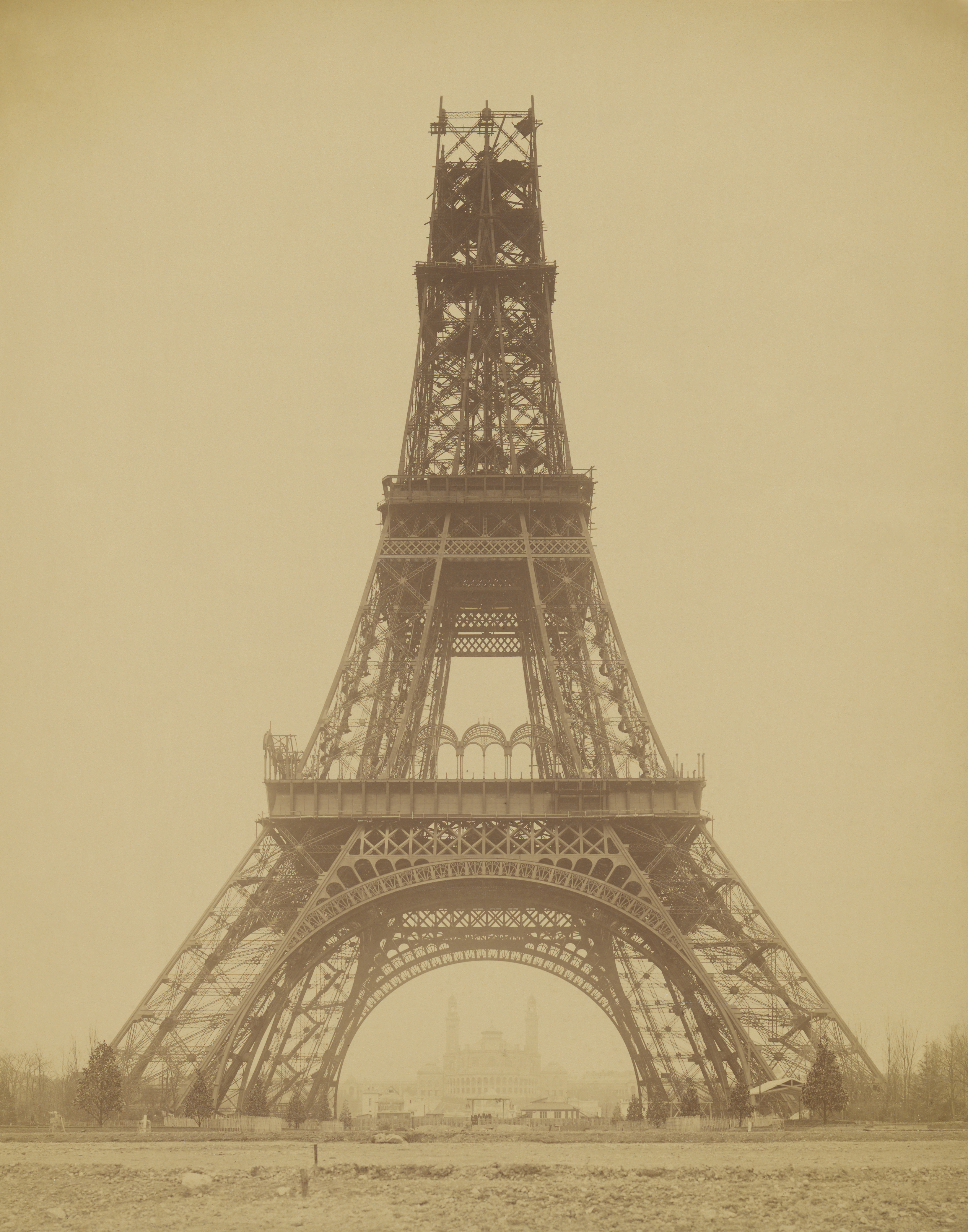
Between 150 and 300 workers built it on site, led by a team of veterans of the great metal viaducts. By November 1888, when Louis-Emile Durandelle took this photograph, the second platform was up. The tower was finished on 31 March 1889, with 18,038 metal parts and 2,500,000 rivets.
The curve of those four piles is where Chiaro’s audio guide app for the Eiffel Tower starts its walk, out on the Champ de Mars. Its five stops play free in a web browser, with nothing to install, and after that the app narrates whatever part of the ironwork a visitor photographs.
Lethbridge, 1909: the same towers on the Crowsnest route
Cranbrook began as a railway town when the Crowsnest Railway arrived in 1898. In 1998, for the line’s centennial, the Canadian Museum of Rail Travel traced the whole route online. It runs from Lethbridge in Alberta west through the Crowsnest Pass to Fernie, Cranbrook and Creston, and on along Kootenay Lake to Nelson.
At the Alberta end of that route, the Canadian Pacific Railway had its own deep valley to cross, at the Oldman River, and its answer was the Lethbridge Viaduct. Finished in 1909, it is just over a mile long and was put together with almost 1,400,000 rivets. It stands on 33 braced, riveted steel towers carrying plate girder spans. Garabit’s approach spans work the same way, with a deck carried on a row of lattice iron piers, and they were finished 25 years earlier.

The last span went into place early on the afternoon of 22 June 1909. Later that day, flatcars carrying 100 men and women in their finest clothes rolled across. In 2005 the Historic Sites and Monuments Board of Canada recognised the viaduct’s construction as a National Historic Event, and Canadian Pacific trains still use it.
At the Cranbrook History Centre, the O gauge model railway sends its trains through a landscape resembling British Columbia’s Kettle Valley, along high mountain ledges and over tall trestle bridges.
Sources: Société d’Exploitation de la Tour Eiffel, Origins and Construction of the Eiffel Tower and La naissance de la tour Eiffel, and its biography of Gustave Eiffel. CNRS News, Who Built the Eiffel Tower?, with Bertrand Lemoine. Bibliothèque nationale de France, Passerelles, Le viaduc de Garabit. Galt Museum and Archives, Enduring Service of the High Level Bridge, 2014. Canadian Society for Civil Engineering, Lethbridge Viaduct. Parks Canada, Construction of the Lethbridge Viaduct National Historic Event. Canadian Museum of Rail Travel, Crowsnest Railway Route, 1998.
Image credits
- Image 1: the Garabit viaduct under construction, 18 April 1884, by J. P., Bibliothèque nationale de France via Wikimedia Commons, public domain
- Image 2: pylon 300 metres high, preliminary design by Émile Nouguier and Maurice Koechlin, 6 June 1884, Wikimedia Commons, public domain
- Image 3: The Eiffel Tower, State of the Construction, 1888, by Louis-Emile Durandelle, J. Paul Getty Museum via Wikimedia Commons, public domain
- Image 4: Lethbridge Viaduct with Canadian Pacific Railway trains, by Pazakui, Wikimedia Commons, licence Creative Commons Attribution 4.0 International (CC BY 4.0)